Quality Assurance and Inspection for CNC Machined Parts
Quality assurance in CNC machining refers to the systematic inspection and verification processes used to confirm that machined parts meet dimensional, geometric, and surface finish requirements. Olympus Machining LLC is a CNC machining shop in Hanover, Pennsylvania that integrates quality verification into every stage of production.
From first article through final shipment, our quality assurance approach is built on careful measurement, documented procedures, and attention to detail. Working with a dedicated precision CNC machining vendor means every part is verified before it ships.
Coordinate Measuring Machine (CMM) Inspection
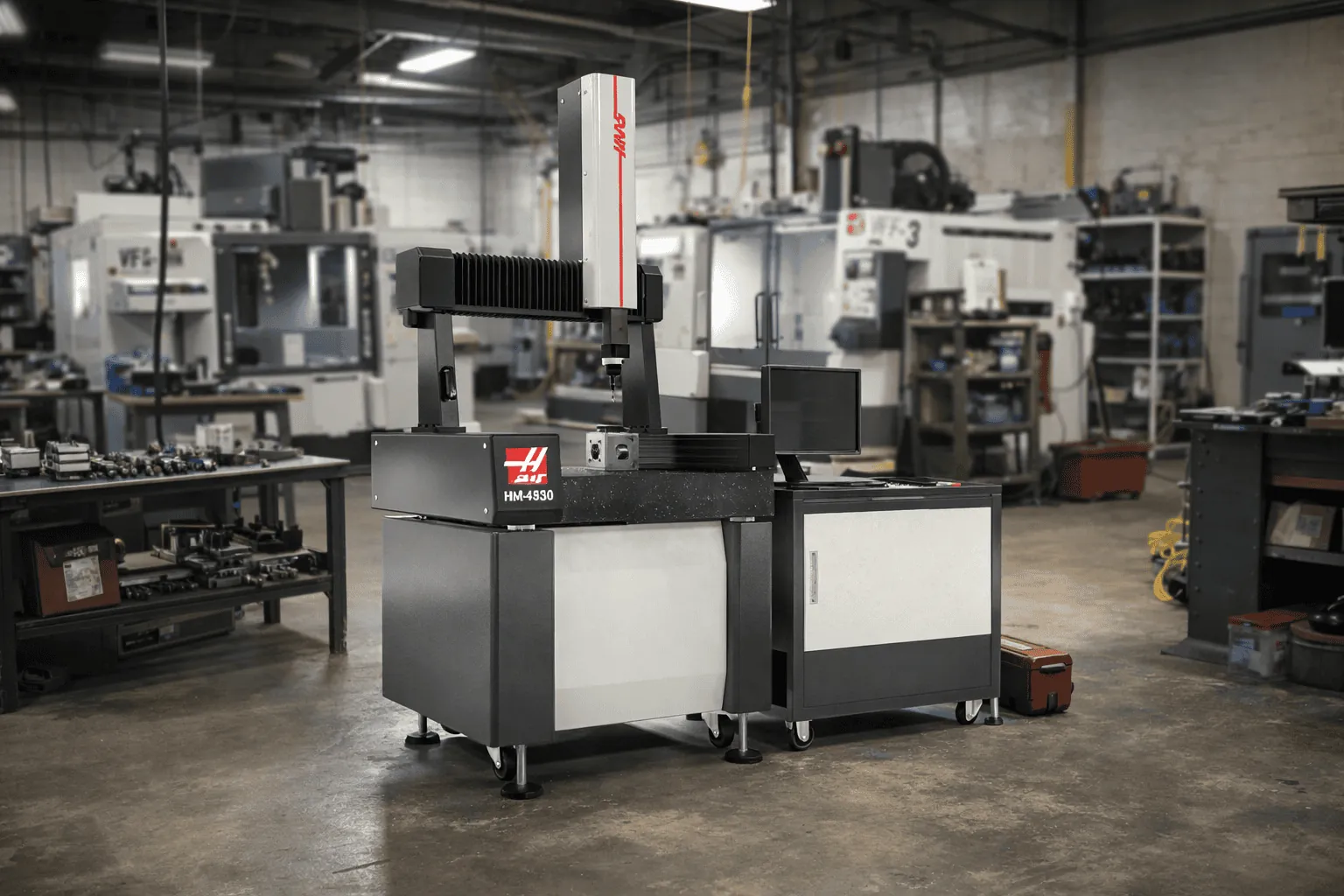
Haas HM-4930 CMM used for dimensional verification and quality assurance.
Olympus Machining utilizes a dedicated coordinate measuring machine (CMM) to support dimensional inspection and verification of machined components. CMM inspection is used to confirm critical features, tight tolerances, and geometric accuracy in accordance with customer specifications.
This capability supports first article inspection, in-process verification, and final inspection to help ensure consistent, repeatable results from prototype through production.
Olympus Machining's inspection capabilities include a Haas HM-4930 coordinate measuring machine (CMM) for dimensional verification and quality assurance.
Inspection Processes
First Article Inspection (FAI)
Before production begins, initial parts are thoroughly measured and verified against customer prints. First article inspection confirms that setups, tooling, and machining parameters produce parts that meet all specified requirements.
In-Process Inspection
Critical dimensions are verified during machining to catch deviations early. In-process checks allow adjustments before parts move to subsequent operations, reducing scrap and ensuring consistency throughout the run.
Final Inspection
Every part undergoes final inspection before shipment. Dimensions, surface finish, and workmanship are verified to confirm conformance to print requirements. Parts that do not meet specification are not shipped.
Measurement and Verification
Olympus Machining uses precision measuring tools and methods to verify dimensions and tolerances according to customer prints. Our measurement equipment includes digital calipers, micrometers, height gauges, bore gauges, thread gauges, and surface plates.
Critical features are measured against specified tolerances, and results are documented for traceability. When customers require inspection reports or dimensional data, we provide clear documentation of measured values.
Commitment to Consistency
Process discipline and verification ensure repeatable results across prototype and production work. Documented setups, controlled tooling, and systematic inspection allow Olympus Machining to deliver parts that match approved specifications run after run.
Whether machining a single prototype or an ongoing production program, our approach remains the same: plan carefully, machine accurately, and verify before shipment.
Why Quality Matters
Quality assurance is essential for OEMs and manufacturers who depend on precision components for their products. When parts meet specification, customers benefit from:
Quality Control Process at Olympus Machining
Olympus Machining applies a structured quality control process that covers every stage of production — from the moment raw material arrives through the final shipment to the customer. Each phase is designed to catch problems early, prevent nonconforming parts from advancing, and provide a complete documentation trail.
1. Incoming Material Verification
Before any material is placed on a machine, it is verified against the material certification provided by the supplier. This includes confirming the alloy designation, heat number, lot number, and any mechanical or chemical property requirements called out on the customer drawing. Heat and lot traceability is maintained so that any finished part can be traced back to the specific raw material from which it was made. This is particularly important for defense, aerospace, and medical programs where traceability is not optional.
2. First Article Inspection (FAI)
The first production unit from any new setup is subject to first article inspection before the full run proceeds. FAI confirms that the machining setup, tooling, fixture, and programmed offsets produce a part that meets all specified dimensions, tolerances, and surface finish requirements. Results are documented, and the setup is only released for production once the first article is confirmed conformant. FAI is also triggered by engineering changes, tool replacements on critical features, or any deviation from the approved process.
3. In-Process Inspection
Critical dimensions are checked at defined intervals during machining runs. Operators measure key features after tool changes, at regular part-count intervals, and whenever a process variable changes. This in-process monitoring mirrors the logic of Statistical Process Control (SPC): by tracking critical dimensions over the course of a run, deviations from target can be identified and corrected before they produce nonconforming parts. In-process inspection significantly reduces scrap and rework compared to relying solely on final inspection.
4. Final Inspection
Before any part ships, it undergoes final inspection. Critical features identified on the customer drawing are measured and verified against the specified tolerances. For tight-tolerance work, this includes use of our Haas HM-4930 CMM to verify dimensional accuracy on complex features. Surface finish is checked on callout surfaces. Parts that do not conform to specification are quarantined and do not ship. There are no exceptions to this gate.
5. Documentation Package
Each shipment is accompanied by documentation appropriate to the program requirements. At minimum, every shipment includes a Certificate of Conformance (CoC) and a copy of the material certification. For programs requiring it, dimensional inspection reports and first article documentation are also included. The documentation package ships with the parts and serves as the traceability record for the customer's receiving inspection.
6. Non-Conformance Handling
When a nonconforming condition is identified — whether during in-process inspection, final inspection, or as a customer-reported issue — it is handled through a formal nonconformance record (NCR) process. Nonconforming parts are immediately segregated and tagged. The root cause of the nonconformance is investigated, and a corrective action is developed to prevent recurrence. This process ensures that problems are not simply fixed and forgotten, but are analyzed and addressed at the process level.
Inspection Equipment and Capabilities
Precision machining requires precision measurement. Olympus Machining maintains a range of calibrated inspection equipment suited to the tolerances encountered in typical CNC machining work. Each tool is selected for the type of feature being measured and the tolerance range specified.
Digital Calipers (±0.001" resolution)
Digital calipers are used for rapid verification of outside diameters, inside diameters, lengths, depths, and step dimensions. With a resolution of ±0.001", they are appropriate for general-tolerance features and serve as the everyday workhorse of the inspection station.
Outside Micrometers (0–6" range, ±0.0001" resolution)
Outside micrometers provide significantly higher resolution than calipers and are used to verify tight-tolerance turned diameters, shaft dimensions, and any external feature where a tolerance of ±0.001" or tighter is specified. Our set covers 0–6" in one-inch increments.
Bore Micrometers and Telescoping Gauges
Bore micrometers and telescoping gauges are used to measure internal bore diameters with precision. Telescoping gauges transfer the bore size for measurement with an outside micrometer, while bore micrometers provide direct readings for precision bores where fit and clearance are critical.
Height Gauges on Granite Surface Plate
Height gauges referenced to a certified granite surface plate are used to verify step heights, boss heights, shoulder locations, and flatness references. The granite surface plate provides a dimensionally stable reference datum for all height-based measurements.
Thread Gauges (Go/No-Go for UN, UNF, UNC)
Go/no-go thread gauges verify that threaded features conform to the specified thread class and fit. The go gauge confirms the thread is within the minimum material condition; the no-go gauge confirms it does not exceed the maximum material condition. This method is used for both tapped holes and threaded ODs.
Pin Gauges and Plug Gauges
Pin and plug gauges provide fast, definitive verification of hole diameters to tight tolerances. A go pin confirms the hole is at or above minimum size; a no-go pin confirms it does not exceed maximum size. This method eliminates measurement uncertainty for close-tolerance hole features.
Surface Roughness Tester (Ra Measurement)
A contact profilometer is used to measure surface roughness (Ra) on finished surfaces where a specific finish callout appears on the drawing. The instrument traverses the surface and reports the arithmetic average roughness value, which is compared to the specified Ra requirement.
Optical Comparator (Profile Inspection)
An optical comparator projects a magnified silhouette of a part profile, allowing visual verification of radii, angles, contours, and overall form. It is particularly useful for checking small-feature geometry and profile conformance on turned or milled contours.
First Article Inspection (FAI) Explained
A first article is the first production unit machined from a given setup, intended to prove that the setup, tooling, fixtures, and programmed parameters produce a part that conforms to the customer drawing in every respect. It is not a prototype — it is a full-production part inspected exhaustively before the remainder of the run proceeds.
When Is FAI Required?
First article inspection is performed whenever a new part is introduced into production, a new setup is established for a recurring part, an engineering change order (ECO) modifies the design, a critical cutting tool is replaced, or a process variable changes in a way that could affect conformance. The logic is simple: any time the process changes, the first output of the new process must be verified before committing to a full production run.
What Does an FAI Report Include?
A complete FAI report includes a ballooned drawing — a copy of the customer print with each dimension, tolerance, and note assigned a balloon number — paired with a measurement data sheet that records the nominal value, the tolerance, the actual measured value, and a pass/fail determination for each ballooned characteristic. Every feature on the drawing is accounted for, leaving no dimension unverified. The report is signed, dated, and retained as a quality record.
AS9102 Methodology
AS9102 is the aerospace standard that defines the requirements for first article inspection reporting in aviation, space, and defense manufacturing. While Olympus Machining is not formally AS9102 certified, we follow the same core methodology — ballooned drawings, complete dimensional verification, material traceability, and documented results — because these practices represent the correct way to perform FAI regardless of the certification context. Customers in defense and aerospace who require FAI documentation receive reports that align with this methodology.
FAI is closely tied to our broader compliance and traceability posture. Learn more on our Compliance page.
Material Traceability and Certification
Material traceability is the ability to link any finished part back to the specific raw material from which it was produced — including the supplier, heat number, lot number, alloy chemistry, and mechanical properties. For defense and aerospace programs, this traceability is a program requirement, not a preference. For commercial work, it provides a critical backstop if a field issue ever requires investigation.
Mill Certificates
A mill certificate (also called a material test report or MTR) is a document provided by the raw material supplier that certifies the actual chemical composition and mechanical properties of the material in a specific heat or lot. It includes the heat number, lot number, alloy designation, product form, applicable specification (such as AMS, ASTM, or MIL), measured tensile strength, yield strength, elongation, and chemical analysis. Olympus Machining retains mill certs for all material used in production.
How Traceability Is Maintained
When raw material arrives, the mill cert is matched to the purchase order and the physical stock. Material is tagged or labeled with its heat and lot identification. When stock is cut for production, the traceability information travels with the material through machining. The finished part's documentation package includes or references the associated mill cert, creating an unbroken chain from the steel mill (or aluminum mill) to the customer's receiving dock.
Certificate of Conformance (CoC)
A Certificate of Conformance is a signed statement by Olympus Machining attesting that the parts being shipped were manufactured in accordance with the specified drawing revision, applicable specifications, and any special requirements called out on the purchase order. It identifies the part number, revision, quantity, purchase order number, and any relevant material or process information. A CoC ships with every order.
Material traceability supports our ITAR compliance posture and defense program requirements. See our Compliance page and Materials Machined page for additional detail.
Tolerance Verification Methods
Different types of tolerances require different measurement approaches. Using the correct method for each feature type ensures measurement results are accurate, repeatable, and appropriate for the tolerance specified. The following describes how Olympus Machining verifies the most common tolerance types encountered in CNC machining work.
Linear Dimensions
Outside lengths, depths, steps, and shoulder heights are verified with digital calipers (general tolerances) or outside micrometers (tolerances of ±0.001" or tighter). The CMM is used for complex prismatic part inspection where multiple linear relationships must be verified simultaneously.
Hole Diameters
Through-holes and counterbores are measured with pin gauges for pass/fail verification, or bore micrometers for actual diameter measurement. For very tight tolerances (H7 fit and tighter), bore micrometers are used with the CMM as backup for critical features.
Position Tolerances
True position of holes and features is verified using a height gauge on a granite surface plate for simpler cases, or the CMM for complex position callouts involving multiple datums or tight position tolerances (under 0.005" true position).
Thread Fit
All threaded features are verified with calibrated go/no-go gauges matched to the specified thread size, pitch, and class. This applies to tapped holes (internal threads) and threaded shafts or bosses (external threads).
Surface Finish
Surface roughness callouts are verified with a contact profilometer (Ra measurement) on critical surfaces. For non-critical surfaces, comparison standards (surface roughness comparator blocks) may be used for efficient verification during production.
Concentricity and Runout
Total indicator runout (TIR) and concentricity are verified by mounting the part in V-blocks and sweeping a dial indicator across the feature of interest. This method is standard for turned shaft components where runout relative to a datum diameter is specified.
| Tolerance Range | Feature Type | Typical Inspection Method |
|---|---|---|
| ±0.010" and looser | General dimensions | Digital calipers |
| ±0.001" to ±0.005" | Turned diameters, bores | Outside micrometers, bore mics |
| ±0.0005" and tighter | Critical fits, tight tolerances | CMM, precision micrometers |
| Thread class 2B/3B | Tapped holes, threaded ODs | Go/no-go thread gauges |
| Ra 32–125 µin | Machined surfaces | Profilometer or comparator |
| True position <0.005" | Hole patterns, features | CMM with datum setup |
Quality Documentation Packages
Olympus Machining provides documentation packages tailored to program requirements. Customers specify what they need at the time of quoting or ordering, and the appropriate documentation ships with the parts. The following describes the standard tiers:
Standard Package
Certificate of Conformance (CoC) and material certification. Appropriate for commercial programs where basic conformance documentation is required.
Enhanced Package
CoC, material certification, and a dimensional inspection report documenting measured values for critical features. Used when customers perform receiving inspection and need actual measurement data.
Full Package
CoC, material certification, complete FAI report (ballooned drawing with full measurement data), and process records. Used for new part introductions, engineering-change parts, and programs where first article documentation is a contractual requirement.
Defense / ITAR Package
All of the above, plus any program-specific documentation required by the customer's quality plan or government contract. This may include special process certifications for heat treatment, plating, or anodizing performed by qualified outside processors.
Documentation requirements can be discussed during quoting. Visit our Prototype to Production page to learn how quality documentation integrates with our production workflow.
Quality Assurance for Defense and Aerospace CNC Machining
Defense and aerospace programs impose quality requirements that exceed those of general commercial manufacturing. Olympus Machining is built to support these programs as an ITAR-registered machining supplier with CMMC Level 1 compliance.
Controlled Document Handling
Customer drawings, specifications, and technical data packages for defense programs are handled under controlled conditions. Document revision control ensures that production always runs against the current approved revision, and superseded revisions are archived rather than discarded.
Traceability Requirements
Defense and aerospace programs routinely require material traceability from raw stock through finished part, FAI documentation, and process records sufficient to support a source investigation if a field issue arises. Olympus Machining maintains the documentation infrastructure to support these requirements.
Special Process Callouts
Many defense components require special processes such as heat treatment, hard anodize, chromate conversion coating, electroless nickel plating, or passivation. Olympus Machining sources these processes through qualified outside processors who provide their own certifications and traceability records. These process certifications are incorporated into the documentation package delivered to the customer.
Customer Source Inspection
Some defense and government programs require customer or government source inspection (GSI) before parts are released for shipment. Olympus Machining accommodates customer source inspection requests, providing workspace, documentation access, and part availability for the inspection visit.
CMMC Level 1 and CUI/FCI Protection
Olympus Machining operates at CMMC Level 1, which governs the handling of Federal Contract Information (FCI) in accordance with DFARS requirements. This cybersecurity posture ensures that technical data and controlled unclassified information (CUI) received from defense customers is protected in accordance with applicable regulations — including the handling of digital drawings, specifications, and program data.
For a full overview of our compliance posture, see our Compliance page.
Frequently Asked Questions
Have a part ready to quote?
Get StartedFrom the Olympus Machining Blog
Related Services
CNC Milling Services
Multi-axis CNC milling for complex geometries and tight tolerances.
View ServiceCNC Turning Services
Precision CNC lathe machining for shafts, bushings, and cylindrical components.
View ServicePrototype to Production
Seamless support from early-stage prototypes to full production runs.
View ServicePrecision CNC Machining
High precision CNC machining for tight tolerances and critical applications.
View ServiceSubmit Your Project
Tell us about your project requirements and get started with Olympus Machining.
Get Started